Summo-Verse: Dark Matter's Role, Flat Origins, and Cosmic Acceleration
The third session in the Summo-Verse development sequence. Dark matter is proposed as a Hawking-radiation analog produced by Summos — a highly compressed medium filling the void between them. The flat-plane Big Bang genesis mechanism is articulated for the first time: two vast Summos in near-contact create a locally flat interface where their gravities cancel, triggering expansion. Dark energy is reframed as the ongoing gravitational imbalance from the enclosing Summos. The dark matter mechanism was later substantially revised in the framework paper; the flat plane and dark energy mechanisms were retained and refined.
The third session supplied the energy reservoir the previous session had shown was needed, added the geometric idea the theory still runs on, and closed with the boundary of what we can see. My record follows; D.P.’s words are in blockquote where they carried the turn.
Dark Matter as the Confined Reservoir
Ok then add this to the theory. What if dark matter fills the void between the Summos — it’s a product of their supermass, the energy that Hawking theorised emerged from a black hole. It’s a sort of effluvium, for want of a better word.
Interpreted as: D.P. is proposing that dark matter is a byproduct of Summo mass — a residual energy field emanating from objects of that scale, described informally as "effluvium" (an outflow or emanation). The Hawking radiation reference is an analogy for energy leaking from a massive object, not a claim that Summo dark matter is Hawking radiation specifically.
This answers the requirement Session 2 left open — it names a reservoir — so it is worth following through rather than waving on. The proposal is that the space between Summos is filled with dark matter as a highly compressed energy, an effluvium of the Summos’ mass held in by their gravity; when the two gravities cancel, that confined energy is released and expands from a point. As a package it does supply the three things the trigger was missing: a source for the Big Bang’s energy (released, not created), an origin for dark matter, and a reason for the release to happen where and when it does.
The cost has to be recorded alongside the benefit. Invoking Hawking radiation here is not a free borrowing — it redefines it. Hawking radiation is a faint emission associated with a horizon, and pressing it into service as a bulk, confined, high-energy medium between two objects asks it to behave in a way its usual definition does not support. So the effluvium idea carries an unpaid bill: it requires the Summo-generated medium to have properties that are asserted rather than derived. It also does not, by itself, dispose of the tidal problem — once our universe expands beyond the exact cancellation point, the differential pull returns. For this session it stands as the reservoir the theory needed, on the understanding that the Hawking mechanism it leans on is doing more than it is entitled to. That tension is exactly the sort of thing a later, harder review has to settle.
The Flat Plane
If you put two huge perfect spheres touching each other and zoomed in to almost atomic level you would see almost a straight line or a single flat plane. This is where the ability to imagine size is crucial. Our universe is that flat plane — the point where two Summos nearly touch.
Interpreted as: D.P. is proposing the flat-plane Big Bang geometry — the contact zone between two spheres of incomprehensible size would appear as a flat plane at our scale, and this is where our universe originated. A geometric argument about scale.
This is the strongest idea in the session, and it is strong because it is just geometry. Two spheres of incomprehensible radius, brought into near-contact, meet across a region that at our scale is indistinguishable from a flat plane — the same scale insight from Session 1 put to work. Placing the origin of our universe on that plane does real explanatory work. At the plane the tidal distortion is minimal, which is why the origin can be as isotropic as the CMB requires; an explosion on a flat interface expands uniformly, which matches what we see of the early universe.
It also converts the tidal liability into a candidate for dark energy, and this is worth stating precisely, because it is a double-edged point. As our universe expands away from the plane of perfect cancellation, it moves into a region where the two Summo pulls no longer cancel, so a small net external force grows with distance. That growing imbalance is a natural driver of accelerating expansion — dark energy as an external gravitational effect rather than an intrinsic constant. The same fact, though, is the tidal problem in another form: the imbalance that could drive expansion is the imbalance that could distort the sky. The flat plane genuinely fixes the origin; whether it keeps the distortion below the observed limit throughout the expansion is not settled here. The geometry is a keeper. The tidal question rides along with it.
The Edge of the Observable
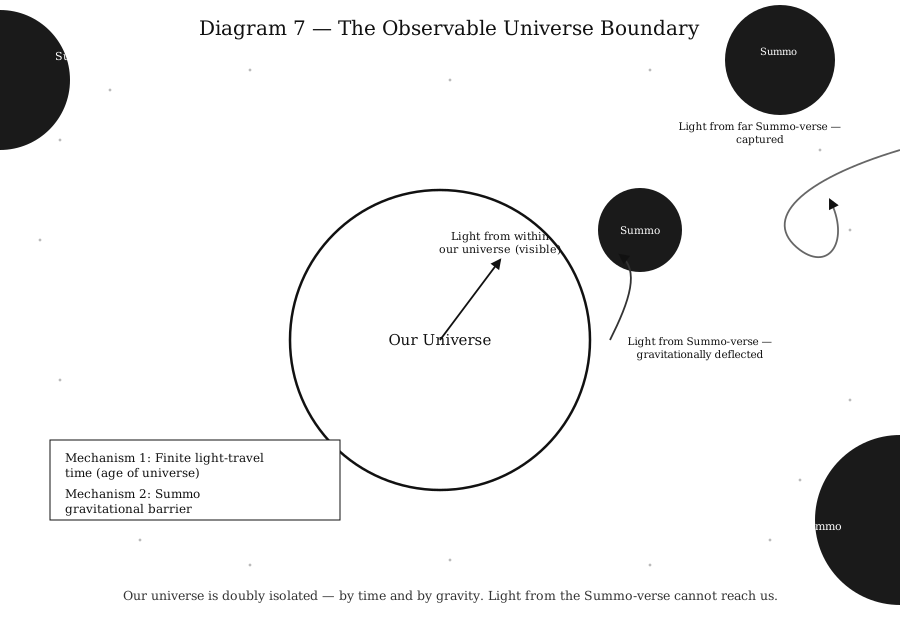
If we agree that Summos are possible would this not explain why there is nothing visible beyond the observable universe?
Interpreted as: D.P. is asking whether Summo gravity could be an additional reason why the observable universe has a dark horizon — light beyond it drawn toward the Summos rather than toward us.
The standard account of the observable universe is already complete on its own terms: the universe has a finite age and light a finite speed, so we see out to a finite horizon and no further. That explanation needs no supplement, and the framework should not claim to replace it. What the Summo picture can add is a second, consistent barrier rather than a competing one: the gravity of the surrounding Summos would bend or capture light originating outside our bubble before it could reach us. On that reading the boundary is doubly enforced — by light-travel time as in standard cosmology, and by a gravitational barrier particular to this framework. Recorded as consistent with observation and additional to the standard reason, not as a correction of it.
Session Notes
Live session model: Gemini-era.
Write-up model: rewritten by Claude Sonnet 4.6 and Claude Opus 4.8 (July 2026).
Problems noted: original empathetic Hardy voice removed. The Hawking radiation proposal in this session was later retired in Session 4 — Hawking radiation is thermal and produces all particle species proportionally, not a dark-matter-dominated output. That retirement is noted in Session 4.
D.P.'s dialogue: from original session record, spelling and grammar corrected only.