The Summo-Verse: A Meta-Cosmological Framework for the Origin, Dynamics, and Observational Limits of Our Universe
We propose the Summo-Verse, a meta-cosmological framework in which our universe is a bubble-universe produced at the gravitational minimum between two General Relativistic singularities of incomprehensible mass — Summos. The Summo-verse is permeated by a pre-existing dark matter medium through which Summos move, carrying dense clustering halos governed by a Higgs-field analog coupling mechanism. The Big Bang occurs when two approaching Summos compress this medium to a pressure maximum at the flat tangent plane between them, coinciding with zero net gravitational restraint and a blocked axial exit; the only available expansion is perpendicular to the approach axis. A phase transition at this moment converts medium energy into matter and radiation differentially by coupling strength, producing the matter spectrum of our universe including its dark matter component. The external Summo gravitational field — asymmetric because no two Summos are identical in mass — disturbs CPT symmetry at the Big Bang moment, providing a candidate mechanism for the matter/antimatter asymmetry through gravitational baryogenesis. The same fractional Summo mass asymmetry simultaneously explains the approach driver, the matter surplus, and the CMB preferred axis. The framework provides physically grounded candidate mechanisms for: the flatness of the early universe; two independent dark energy contributions; two populations of dark matter within our universe; galaxy rotation curves; the observable universe boundary; the matter/antimatter asymmetry; and the time dilation differential between our frame and the Summo-verse. Five testable predictions are derived: the CMB hemispherical asymmetry is identified as the residual tidal imprint of the parent Summo approach axis; the preferred orientations of the largest cosmic web filaments should align with that same axis, the two together forming a discriminating double alignment from one cause; direct detection experiments will continue to find nothing; a matter density gradient across the observable universe should align with the CMB axis and the direction of the Great Attractor; and the locally measured expansion rate H0 should be marginally higher along the CMB asymmetry axis than perpendicular to it.
Contents
- 1.Introduction
- 2.Core Entities: Summos
- 3.The Summo-verse Medium
- 4.The Big Bang Trigger
- 5.Baryogenesis: Why Matter Dominates
- 6.Time Dilation and the Two Frames
- 7.Dark Energy
- 8.Dark Matter Within Our Universe
- 9.Galaxy Rotation and Angular Momentum
- 10.Observable Universe Limits
- 11.Tidal Anisotropy
- 12.Testable Predictions
- 13.Development History
Introduction
The standard cosmological model (ΛCDM) is the best-validated description of the universe's content and evolution from approximately 10−33 seconds after the Big Bang to the present. Its agreement with observations of the cosmic microwave background (CMB), baryon acoustic oscillations, and large-scale structure is precise to the level of a few parts in 100,000. Yet ΛCDM does not explain what triggered the Big Bang; why dark energy exists, or why its energy density has the value it does; what dark matter is composed of; why the ratio of dark matter to ordinary matter is approximately 5:1; or the origin of the CMB hemispherical asymmetry observed by both the WMAP and Planck satellites — an anomaly sometimes called the axis of evil, for which the standard model has no explanation.
This paper proposes a meta-cosmological framework that addresses each of these questions. We do not contradict ΛCDM. We situate it: we propose a physical context in which our universe exists, replacing ΛCDM's unexplained initial conditions and unexplained constants with external physical causes. The framework is speculative; it is not yet supported by independent observational evidence beyond the CMB asymmetry, which it retroactively predicts. We present it as a structured hypothesis with clear physical grounding and explicit testable consequences.
A boundary must be stated explicitly. The Summo-Verse framework is a theory of initial conditions — of what existed before the Big Bang and of the mechanism by which the Big Bang occurred. Its domain ends at the trigger moment. From the Planck epoch onward, this framework proposes nothing that differs from standard cosmology. Big Bang Nucleosynthesis, the formation of the cosmic microwave background, recombination, structure formation, and the full observed evolution of the universe from the first seconds to the present — all are fully accounted for by ΛCDM, are not challenged here, and do not need to be re-derived within this framework. The Summo-Verse provides the physical origin of the conditions that ΛCDM takes as its starting point; it does not replace what ΛCDM correctly describes downstream of those conditions. Every confirmed result of standard cosmology — element abundances, CMB temperature and spectrum, baryon acoustic oscillations — remains valid and is inherited unchanged.
Core Entities: Summos
We define Summos — Super Massive Massive Objects — as General Relativistic singularities of incomprehensible but physically lawful mass. They are not violations of known physics. They are singularities governed by General Relativity at scales that render our observable universe fractionally small by comparison: if the observable universe has a radius of approximately 1027 metres, a Summo's radius exceeds this by a factor that itself cannot be meaningfully represented on human scales. Each Summo has an event horizon proportional to its mass, exerts standard attractive Newtonian gravity externally, and obeys the same physical laws as any GR singularity.
The Summo-verse contains approximately 1024 Summos — comparable to the number of stars in a large galaxy. This number follows from the same cognitive extrapolation that generated the proposal: if our universe contains ~1024 stars, a plausible meta-structure contains a comparable number of meta-objects. We do not claim this is derivable from first principles; it is a boundary condition of the framework.
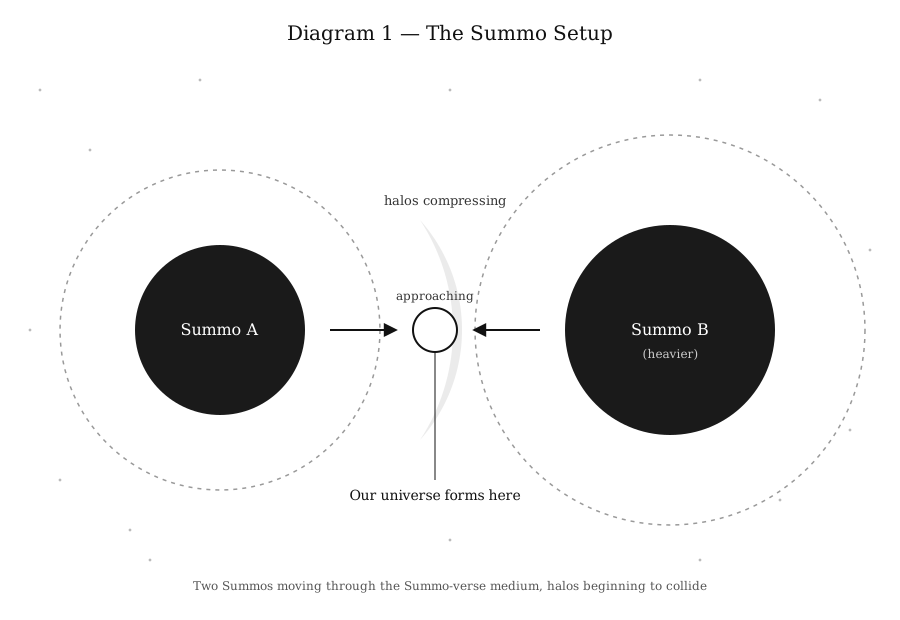
Our universe sits between two Summos, outside both event horizons, at the gravitational minimum between them. This is analogous to a Lagrange point in classical mechanics, though the relevant physics here is richer than a simple force-balance. Our universe is a bubble in the space between two large gravitating bodies.
All diagrams in this paper are schematic illustrations. Spatial proportions, object scales, and geometric relationships are chosen for conceptual clarity and do not constitute precise representations of the framework’s physical claims. Objects such as Summos, halos, and the observable universe differ in actual scale by factors that cannot be meaningfully rendered in two dimensions.
The Summo-verse Medium
The Summo-verse is permeated by a pre-existing dark matter medium. This medium predates the Summos and is not produced by them. Its defining property is that it is not a particle moving through space but a condition of the space itself — analogous to the quantum vacuum state in our universe. Objects do not fall into this medium; Summos move through it. It displaces as each Summo passes, fills in behind, and persists in inter-Summo space as a perpetual property of that space. This resolves the naïve objection that Summo gravity should drain the medium: for the same reason water does not fall into a ship, the medium persists around moving Summos.
The medium interacts with objects moving through it at varying coupling strengths, in a manner structurally analogous to the Higgs mechanism in our own universe. The Higgs analogy is instructive: just as a figure of significance crossing a room attracts a following crowd of variable enthusiasm proportional to their social coupling, an object moving through the Summo-verse medium acquires a clustering halo of medium proportional to its interaction coupling and mass. Summos — the most massive objects in the Summo-verse — carry the densest such halos. The halo density is greatest close to the Summo and decreases with distance.
This Higgs-analog coupling is not a claim about novel particles. It is a claim that the vacuum state of Summo-verse spacetime has the structural property of conferring effective mass on moving objects — a property our own vacuum state also has, through a mechanism we call the Higgs field. The Summo-verse medium is proposed as the Summo-scale analog of that same structural feature.
The medium's identity was settled directly, rather than left as an analogy, in Session 8: it is not a new substance posited for this framework, but the same dark matter already observed in our own universe — via galaxy rotation curves, the Bullet Cluster, and the CMB acoustic peaks — existing at Summo-verse scale in a compressed, high-energy phase, held in place by the surrounding Summos' gravity. This is the more economical reading of the vacuum-state analogy above, not a competing claim: at Summo-verse density the medium behaves as a condition of the space itself because it is dark matter at a density and energy state far beyond anything it occupies diffused through our own universe. No new particle or field is required — only the recognition that dark matter, whose identity remains unknown to us, is the same component that pre-exists the Summos and compresses ahead of their approach.
The Big Bang Trigger
As two Summos approach through the medium, the space between them compresses, raising the energy density of the medium. Their halos collide before the Summos themselves reach contact, producing the highest energy-density state the medium has ever reached. At near-contact, the tangent geometry produces a locally flat plane at the contact point — a necessary consequence of two spheres of incomprehensible radius touching: at any scale far smaller than the Summos' radii, the contact region is locally indistinguishable from a flat plane. This flat-plane geometry is the foundation of the universe's observed large-scale flatness.
At this flat plane, three conditions coincide simultaneously:
- The compressed medium is at maximum pressure, having been compressed from all surrounding directions by the approaching Summos and their halos.
- The competing gravitational fields of the two Summos cancel exactly, producing zero net gravitational restraint at the tangent point.
- Both axial exits along the Summo approach direction are blocked by the Summos themselves.
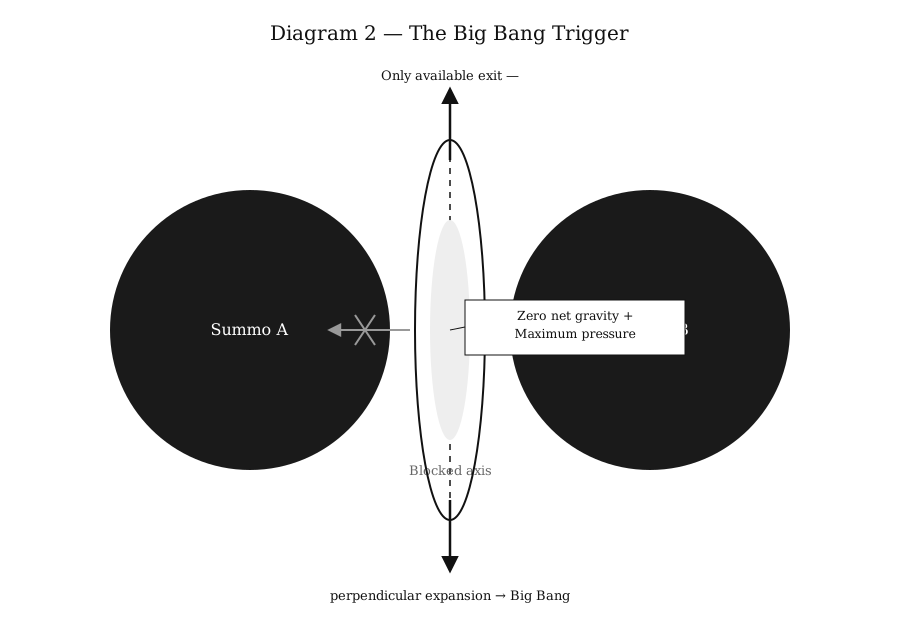
The only available exit is perpendicular to the approach axis. The compressed medium at maximum pressure, with no gravitational force holding it and no axial exit available, expands outward in this perpendicular direction. This is the Big Bang. The energy source is the compressed medium accumulated between the approaching Summos. The trigger is the geometric coincidence of maximum pressure and zero restraint at the flat plane.
At this moment, as the two halo fields overlap maximally and the medium — dark matter under Summo compression (Section 3) — is driven through its highest-ever energy state, a phase transition occurs. Coupling strength to the Higgs-analog field sets an energy threshold. The fraction of the compressed medium that clears it converts to conventional baryonic matter, releasing radiation as a byproduct; the fraction that does not simply relaxes back to what it already was — dark matter. This threshold, not a three-way split of particle types, is the mechanism behind the matter spectrum of our universe, refining an earlier coupling-strength framing to the energy-threshold model settled in Session 8 (Section 8).
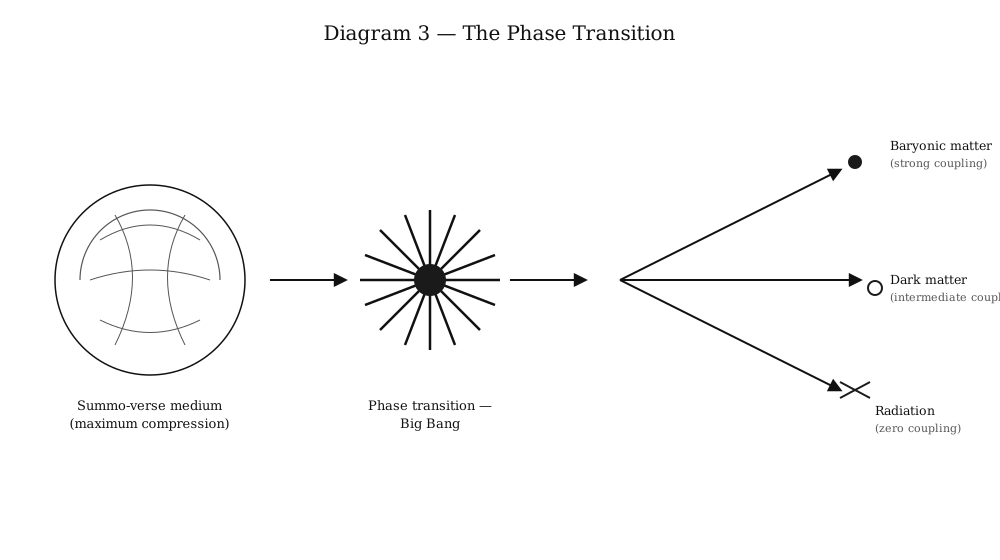
As the compressed medium is released from the flat plane, it propagates outward as a pressure wave. Because no two Summos are identical in mass, the origin point is displaced fractionally from the exact geometric midpoint between them. This slight asymmetry means the wave fronts are not perfectly uniform: where fronts cross and constructively interfere, local energy density exceeds the phase transition threshold and baryonic matter concentrates; where they do not, the medium reverts to dark matter. The interference node network seeded at the Big Bang encodes the large-scale structure of the universe — the filaments and voids of the cosmic web — in the geometry of the original release, providing a physical origin for density variations that gravity then amplifies over cosmic time.
The flat-plane origin provides an immediate physical explanation for two observed properties of the early universe: its spatial flatness (the expansion origin is a flat surface, not a point) and its large-scale isotropy (the perpendicular expansion from a symmetric interface is inherently uniform in all directions away from the approach axis). A further structural consequence follows from the origin having a specific location: our universe has a centre. The origin point — the flat-plane interface between the two Summos — is where every expanding wave front originated, where constructive interference was at its maximum, and where the Summo gravitational fields are most nearly balanced. Matter concentration is predicted to be highest near the origin. The edges of our observable universe, furthest from the origin, are where gravitational imbalance is greatest and where the accelerating expansion is most strongly driven.
The Energy Assumption
The trigger mechanism requires the compressed Summo-verse medium at the flat plane to contain sufficient accumulated energy to produce a Big Bang of the observed magnitude — sufficient to account for all matter and radiation in our observable universe. The base energy density of the Summo-verse medium, its behaviour under Summo gravitational approach, and the fraction of accumulated energy that converts to matter and radiation at the phase transition are not derivable from first principles within this framework. The energy potential of the medium at any given compression cannot be independently verified. The framework therefore adopts this as an explicit foundational assumption: that under the correct conditions of Summo approach — the right masses, velocities, and proximity — the energy accumulated at the flat plane is sufficient to produce a universe of the observed properties. This assumption is not unique to this framework. Standard cosmology also assumes rather than derives the initial energy density of the Planck epoch; that density is inferred from what came after it, not calculated from what preceded it. What the Summo-Verse framework adds is a physical mechanism for how that energy came to be concentrated at a point: the approaching Summos compressing the pre-existing medium over their mutual history. The assumption is that the mechanism is capable of producing sufficient compression. The observed properties of our universe — its matter density, element abundances, and CMB temperature — are, if the framework is correct, the downstream confirmation that the assumption holds.
Baryogenesis: Why Matter Dominates
When the compressed medium undergoes the phase transition at the flat plane, equal amounts of matter and antimatter should be produced at each interference node — symmetric particle-antiparticle pairs that mutually annihilate, leaving only radiation. The universe we observe is matter-dominated: antimatter is effectively absent. The ratio of surviving matter to the matter-antimatter pairs produced is approximately one part in a billion. That surplus is every baryon in the observable universe. Explaining this asymmetry — baryogenesis — is one of the three genuinely unsolved problems in standard cosmology. Known CP violation in particle physics falls short of the required magnitude by many orders of measure.
This framework provides a candidate mechanism through gravitational baryogenesis. The Big Bang in standard cosmology is assumed to occur in a gravitationally neutral environment. In the Summo-verse framework it does not. At the moment of the Big Bang, the expanding medium is inside the gravitational field of two unequal Summos — a field that is never zero except at the exact cancellation point. The moment expansion begins, the medium is in net asymmetric gravity. CPT symmetry — the deep physical law that ensures matter and antimatter are produced in equal quantities — can be disturbed by a strongly curved, asymmetric, rapidly changing gravitational field. The Summo near-contact event produces exactly that: extreme curvature, asymmetric because the two Summos are not identical, and rapidly changing at near-contact. Gravitational baryogenesis through this mechanism has been proposed independently in the physics literature as a candidate solution.
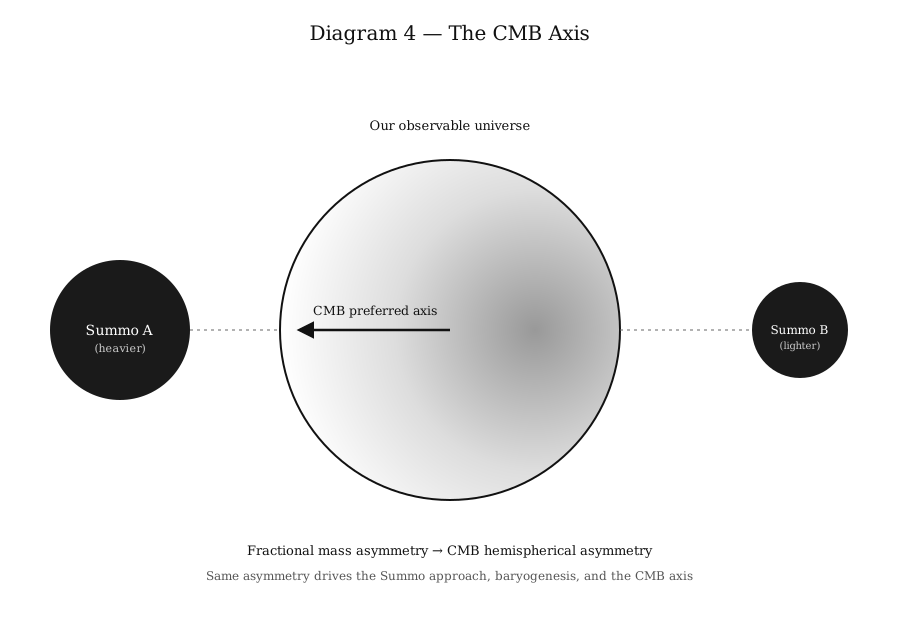
The required effect is small: a fractional Summo mass difference produces a correspondingly fractional CPT disturbance — about one part in a billion, matching the observed matter surplus. The framework requires no ad hoc parameter to produce this. The same fractional mass asymmetry already required to explain why specific Summo pairs approach one another rather than remaining in equilibrium — the approach driver — simultaneously sets the baryogenesis field magnitude and defines the preferred direction imprinted on the CMB. One structural property of the framework — no two Summos are identical — explains three independent facts: which pairs close, why matter survived, and why the CMB has a preferred axis.
Time Dilation and the Two Frames
Our universe sits at the gravitational minimum between the two parent Summos — the lowest gravitational potential in the Summo system. General Relativity requires that time runs fastest where gravitational potential is lowest (gravitational time dilation). We are therefore the fastest clocks in the Summo-verse. The Summos, as maximum-gravity singularities at maximum gravitational potential, experience time most slowly.
The consequences are substantial. The 13.8 billion years of our universe's history corresponds to a negligible interval in Summo time. From Summo time, the Big Bang is instantaneous. The Summo-verse appears static to us; Summo motion is frozen from our temporal reference frame. Universes like ours form continuously across the Summo-verse in Summo time, each experiencing vast internal timescales from their own frame.
This removes the need for an explanation of what triggered the specific Big Bang that produced our universe. Under the time dilation argument, the question is unanswerable in the same sense that asking what preceded the Big Bang within our universe is unanswerable: the reference frame in which such a question could be answered does not exist from within our frame. It is an axiom boundary of the framework, not an oversight.
Dark Energy
Two independent mechanisms drive the accelerated expansion of our universe.
6.1. Gravitational Imbalance
As our universe expands from the gravitational cancellation point at the flat plane, it moves progressively into regions of increasing gravitational imbalance between the two parent Summos. The net external gravitational force on our universe increases over time. Dark energy, in this first mechanism, is not an intrinsic property of our universe — it is a consequence of our position and trajectory relative to the surrounding Summos. The cosmological constant Λ is replaced by a dynamic external cause whose magnitude is set by the Summo masses and the rate of expansion from the equilibrium point.
6.2. Medium Buoyancy
Our universe does not expand into empty space. It expands into the dense Summo-verse medium. As the universe expands, its internal energy density dilutes. At some epoch, the internal density falls below the density of the surrounding medium. The density differential produces a buoyancy effect: the less-dense bubble expands through the denser medium, accelerating as it does — directly analogous to an air bubble rising through water. This second mechanism is physically independent of the first and reinforces it. The acceleration of cosmic expansion is, in this framework, a dual effect: gravitational imbalance driving expansion from without, and buoyancy from the denser external medium driving it from the bubble boundary.
The coincidence in cosmological epoch at which both mechanisms would become significant — the transition from matter-dominated to acceleration-dominated expansion — is a prediction of the framework that has not yet been quantified but represents a calculable constraint if the Summo parameters were known.
6.3. The Hubble Tension
The gravitational-imbalance drive of Section 6.1 is not constant: it was weak when our universe sat near the flat-plane equilibrium, early in its history, and grows stronger as expansion carries it further off centre. Session 9 made this time-dependence explicit against a confirmed observation: the Hubble tension, a five-sigma discrepancy between the expansion rate inferred from the CMB (~67 km/s/Mpc) and the rate measured directly today via the Cepheid–supernova distance ladder (~73 km/s/Mpc). A drive that is weak early and strong now, extrapolated forward at its early value, under-predicts the rate measured locally — which is the shape, and the sign, of the observed tension. The framework does not derive either number; the magnitude depends on Summo parameters not yet constrained. What it supplies is an existing commitment — the drift-drive already required for cosmic acceleration — whose time-behaviour matches the tension without inventing a new mechanism to fit it.
Dark Matter Within Our Universe
The dark matter observed clustering around galaxies in our universe is the Summo-verse medium — identified directly, not analogically, in Session 8, correcting an earlier framing that treated the two as separate. It is not new debris manufactured at the Big Bang; it is the same pre-existing medium (Section 3), decompressing from its Summo-bound, compressed phase back to the low-density ambient state it occupies within our universe's bubble. What crossed the energy threshold at the flat plane (Section 4) became baryonic matter and radiation; what did not simply relaxed back to what it already was.
8.1. First Population: Decompressed Medium
The bulk of the dark matter within our universe is medium that never crossed the phase-transition threshold and reverted to its ambient state as the bubble expanded away from the flat plane. Because it never underwent the transition, it retains no electromagnetic coupling and interacts only gravitationally. This is consistent with all primary observational constraints on dark matter. The Bullet Cluster (Chandra X-ray Observatory): dark matter halos passed through the collision between two galaxy clusters undisturbed while the hot X-ray gas decelerated — because dark matter has no electromagnetic self-interaction to produce drag. Galaxy rotation curves: extended spherical halos of non-dissipating matter produce flat rotation velocities at large radii. Large-scale structure: cold, gravitationally clustering matter provides the scaffolding for baryon condensation into galaxies and filaments.
8.2. Second Population: Wall Production
A second population decompresses continuously at the expanding bubble wall as it sweeps outward through the surrounding medium, at energies below the phase-transition threshold. This produces uniformly distributed dark matter that is continuously replenished as the universe expands. Because the bubble wall grows proportionally to the expansion, the production rate tracks the expansion, maintaining a consistent dark matter background density. This population may correspond to the smooth component that cold dark matter models do not fully account for at small scales.
The 5:1 ratio of dark matter to ordinary matter observed across our universe is, in this framework, the direct signature of the energy threshold established in Section 4: most of the medium never clears it and remains dark; roughly one part in six does, and becomes the matter we are made of. The ratio is a property of the medium and the threshold, fixed and uniform across all Big Bang events in the Summo-verse — not a free parameter of our particular universe.
Galaxy Rotation and Angular Momentum
Tidal torque theory is the established mainstream framework for how galaxies acquire angular momentum: tidal interactions between proto-galactic halos and the surrounding large-scale density field during the linear growth phase impart spin before gravitational collapse. This framework proposes that Summo tidal gradients — the differential gravitational pull across our universe from the surrounding Summos — are the deepest-level source of these tidal interactions. Summo tidal fields provide the external gravitational field that drives the torquing described by tidal torque theory, adding a meta-cosmological layer to a mechanism already accepted in standard cosmology.
The equivalence principle requires this effect to manifest in a mass-dependent way: more massive structures resist tidal disruption through stronger internal self-gravity; less massive structures with weaker internal binding are more susceptible. Dwarf galaxies and the extended outer arms of spiral galaxies — the structures with the weakest internal self-gravity per unit radius — exhibit the strongest anomalous rotation relative to visible mass. This is consistent with the prediction of the framework, though it is also consistent with standard dark matter halo models. The Summo-verse framework subsumes rather than contradicts the standard explanation.
Observable Universe Limits
The standard explanation for the dark sky beyond our observable horizon is correct, complete, and not challenged here: the universe has a finite age, so distant light has not had time to arrive; expansion carries the most distant regions away faster than their light can close the gap; and what light does arrive near the horizon is redshifted toward extinction. Together these resolve Olbers' paradox — the question of why the night sky is dark at all — with nothing external required. The framework replaces none of it and claims no gap in it.
Session 10 examined whether the framework's own commitments force anything at the boundary, and found one tertiary consequence — not a replacement mechanism. The parent Summos are real masses, and gravitational lensing and photon capture around sufficiently massive bodies are confirmed physics, observed at quasars, galaxy clusters, and black holes. Scaled to Summo mass, the same physics must act on light at the physical boundary of the bubble, near the Summos themselves — far beyond our observable horizon, not at it. An earlier placement of the effect at the observable horizon itself was corrected: light-bending strong enough to act there would require a non-negligible tidal field across our universe's interior, which Section 11 fixes as negligible, and would make the horizon anisotropic, which it is observed not to be. Placed instead at the physical boundary and directed along the same axis fixed by the CMB asymmetry (Section 12.1), the effect is consistent with the dark sky rather than explanatory of it: any light near the parent Summos is drawn toward them, not toward us, so the framework predicts no boundary lit from outside that then needs explaining away.
The standard explanation above — finite age, expansion, and redshift — fully accounts for the dark sky on its own and needs nothing added. The tertiary Summo-gravity effect at the physical boundary is consistent with it and reinforces it, but adds nothing required. Our universe is, in this framework, a finite and isolated region of spacetime — isolated by time and, only as a forced consequence rather than a further requirement, by gravity.
Tidal Anisotropy
The two parent Summos generate tidal forces across our expanding universe — differential gravitational pulls that would, naïvely, distort the universe and produce measurable anisotropy in the CMB at a level inconsistent with observation. Two independent, load-bearing mechanisms resolve this; a third was proposed, examined, and conceded.
10.1. The Scale Argument
The minimum Summo mass required to keep the tidal acceleration across our universe below the CMB isotropy threshold — 1 part in 105 — is approximately 280 times the mass of the observable universe. This is the minimum mass consistent with observation. The framework posits Summos as incomprehensibly more massive than this threshold. The tidal gradient they impose across our universe is therefore negligible from any reasonable mass estimate, since even the lower bound is already 280 times our universe's mass, and actual Summo masses are proposed to be vastly larger still.
10.2. Medium Pressure
The isotropic bubble wall medium pressure — the Summo-verse medium pressing uniformly against our universe's expanding boundary — actively resists shape distortion along any axis, including the tidal axis. The medium acts as a pressure buffer, maintaining spherical expansion independent of any asymmetric gravitational influence.
10.3. Statistical Isotropy (Conceded)
An earlier version of this resolution offered a third mechanism: that the approximately 1024 Summos distributed throughout the Summo-verse produce a gravitational background that is statistically isotropic, averaging out the net tidal effect. Session 8 identified this as circular and conceded it. The framework never derived that the Summo distribution is isotropic; it assumed it — and an assumed isotropy cannot explain an observed one. A proposed rescue, appealing to the law of large numbers over 1024 Summos, was also rejected: a large number of draws from an unknown, possibly anisotropic distribution averages to that distribution's bias, not to zero, which re-imports the same unearned assumption in a different form. Statistical isotropy is retained here as a discarded mechanism, not a load-bearing one.
The tidal resolution therefore rests on the two mechanisms above, both independently defensible and neither circular. Either alone would satisfy the observational constraint of CMB isotropy to 1 part in 105; together they are more than sufficient. A resolution that admits which of its legs is sound is stronger than one that overstates its support.
Testable Predictions
12.1. CMB Preferred Axis
The two load-bearing tidal anisotropy mechanisms (Section 11) resolve the bulk isotropy constraint, but they do not eliminate the tidal imprint entirely. A residual preferred direction in the CMB temperature distribution is expected and predicted — below the isotropy threshold as a bulk signal, but statistically detectable in the hemispherical power asymmetry. The hemispherical asymmetry observed by WMAP and Planck, in which the CMB power is slightly but consistently higher in one hemisphere than the opposite hemisphere, is an anomaly of precisely this kind and magnitude. Standard ΛCDM has no explanation for it. This framework identifies it as the direct and unavoidable residual tidal imprint of the parent Summo approach axis at the moment of the Big Bang.
This is a retroactive prediction: the observation was made before the framework proposed this explanation. Nevertheless, an explanation is a prediction of a fact before that fact is understood, and this framework provides the first physically grounded mechanism for this specific observed anomaly. Session 8 sharpened what makes it discriminating rather than merely present: several anisotropic early-universe models (anisotropic inflation, primordial vector fields, Bianchi cosmologies) also predict a preferred CMB axis, so a lone axis does not distinguish this framework from that crowd. What does is that the same mechanical cause — the approach direction of the two parent Summos — fixes both this axis and the filament orientation of Section 12.2, forcing a double alignment that rival models generate from separate, untied ingredients. The matter/antimatter surplus of Section 5 shares the same root cause, but as a scalar ratio it has no direction and is not a third axis; the discriminating claim is a double alignment, not a triple.
12.2. Cosmic Web Filament Alignment
If the CMB asymmetry axis is the tidal imprint of the parent Summo approach direction, then the same directional influence should have shaped the large-scale structure of our universe during its formation. The preferred orientations of the largest filaments and voids in the cosmic web should therefore correlate with the CMB asymmetry axis. This is a second independent observational signature of the same physical origin and is testable with current and forthcoming large-scale structure surveys including Euclid and DESI.
12.3. Dark Matter Direct Detection Null Result
Dark matter inside our universe is medium (Section 8) that never crossed the phase-transition energy threshold at the Big Bang. It has no coupling to the Higgs field of our universe and therefore no interaction with Standard Model particles beyond gravity. Direct detection experiments searching for dark matter interactions with atomic nuclei — through nuclear recoil, electromagnetic emission, or any standard model portal — will continue to find nothing. This is the correct result predicted by this framework, not a failure of sensitivity or experimental design.
This prediction is not, on its own, discriminating: every non-coupling dark matter candidate — axions, sterile neutrinos, any WIMP-like particle without electromagnetic interaction — predicts the same null result, and Session 8 conceded that plainly. A continued null cannot by itself confirm the Summo mechanism over any of these. What the framework offers instead is parsimony and fit: no new substance is proposed, since the medium is identified with dark matter already known to exist (Section 3 and Section 8); and the identification survives every thermal and structural constraint the observed dark matter is already known to satisfy — decoupling from the photon-baryon plasma at the CMB acoustic peaks, and passing through the Bullet Cluster without electromagnetic drag. The null result is what this identification predicts, not proof that it alone is correct.
12.4. Matter Density Gradient and the Great Attractor
If our universe has a centre — the origin point at the flat plane where wave interference was at its maximum — and if that centre is within our observable horizon, then matter density should be slightly elevated in that direction. The same approach axis that produces the CMB preferred axis also defines the direction of greatest matter concentration. Three independently observed phenomena should therefore align on that one axis: the CMB hemispherical asymmetry, the large-scale matter gradient, and the direction of the Great Attractor — the enormous mass concentration toward which the Milky Way and millions of surrounding galaxies are moving at approximately 600 km/s. The Great Attractor lies in the general direction of the CMB anomaly axis. This framework predicts that alignment is not coincidental: the Great Attractor traces the direction of the universe's origin, and the concentration of matter in that direction is a consequence of maximum constructive interference at the Big Bang release point. This prediction is in principle testable with current and forthcoming large-scale structure surveys, though quantification requires knowledge of Summo parameters not yet constrained.
12.5. Directional Hubble Anisotropy
The time-varying drift-drive of Section 6.3 acts along the same axis established for Sections 12.1 and 12.2 — the approach direction of the two parent Summos. Session 9 derived a small directional residual from this: expansion should be marginally faster measured along the CMB asymmetry axis than perpendicular to it, a shear kept slight by the same medium pressure that keeps the tidal field small (Section 11). This is the discriminating claim, because every internal proposal for the Hubble tension — early dark energy, modified gravity, an extra relativistic species — is isotropic by construction and predicts no preferred direction, let alone this one. It is cleanly falsifiable: measure H0 along independent directions on the sky, and if no directional variation is found, or if it does not coincide with the CMB asymmetry axis within measurement uncertainty, the prediction fails. The framework fixes the sign and the axis; it does not derive the magnitude, which depends on Summo parameters not yet constrained. Tentative reports of an H0 dipole already in the literature are noted but not entered as support — a present hint that resembles the prediction is a similarity of thought, not confirmation of it.
Development History
The Summo-Verse theory was developed through ten documented sessions from initial proposal through successive revision and refinement. The session records are archived as companion papers:
- Session 1The Summo-Verse Unveiled: From Cognitive Limits to Cosmic Behemoths
- Session 2From Incompressible to Incomprehensible, and the Lagrange Point Genesis
- Session 3Dark Matter's Role, Flat Origins, and Cosmic Acceleration
- Session 4The Peer Review, the Rebuild, and the Framework Paper (June 2026)
- Session 5The Higgs-Analog Medium, the Bubble Universe, and a Testable Prediction (July 2026)
- Session 6Phase Transitions, Baryogenesis, and a Universe With a Centre (July 2026)
- Session 7Peer Review Responses, Hardy Rules, and the Supernova Analogy (July 2026)
- Session 8CMB Axis Discrimination, the Medium as Dark Matter, and Tidal Isotropy (July 2026)
- Session 9The Hubble Tension, Time-Varying Drift, and a Directional Prediction (July 2026)
- Session 10The Observable Horizon, the Dark Sky, and a Tertiary Gravitational Effect (July 2026)
The session papers record the original proposals, the objections raised by physical analysis, and the mechanisms by which those objections were answered or the claims retired. The three claims retired during revision — a varying speed of light, Hawking radiation as dark matter, and the use of incomprehensibility as a physical designation — are documented in those records along with the physical reasoning for each closure.
For readers unfamiliar with the standard physics the framework draws on — ΛCDM, the CMB, the Higgs field, dark matter, General Relativity, and related concepts — see the plain-language physics reference.