Summo-Verse: From Incompressible to Incomprehensible, and the Lagrange Point Genesis
The second session in the Summo-Verse development sequence. The critical correction from incompressible to incomprehensible is made, substantially reframing the nature of Summos. Our universe's position at a Lagrange point between two Summos is proposed as a solution to the gravitational dominance problem. The first articulation of the Big Bang trigger mechanism is developed. These ideas were subsequently refined and in some cases rebuilt in the framework paper.
The second session made one correction that mattered and put the theory’s first real mechanism on the table. My record of both follows; D.P.’s words are in blockquote where they carried the turn.
Incomprehensible, Not Incompressible
Rewrite — I meant incomprehensible, not incompressible.
Interpreted as: a correction to the prior session's terminology — Summos are beyond comprehension in scale, not physically incompressible in the material-science sense. A precise and important distinction.
The correction changes what kind of problem a Summo is. “Incompressible” is a claim about matter, and it would put the theory straight into conflict with known physics about how mass and gravity behave. “Incomprehensible” steps back from that: it says the internal nature of a Summo is beyond our current grasp, not that it violates a specific law. That is a weaker and safer claim, but it buys less than it appears to. The scale problem from Session 1 is untouched. If a Summo has mass, its gravity is colossal whether or not we can comprehend its interior, and the uniformity of our universe still has to be reconciled with that gravity. The relabelling removes a contradiction; it does not remove the gravitational dominance problem, which still needs a mechanism.
Our Universe at a Lagrange Point
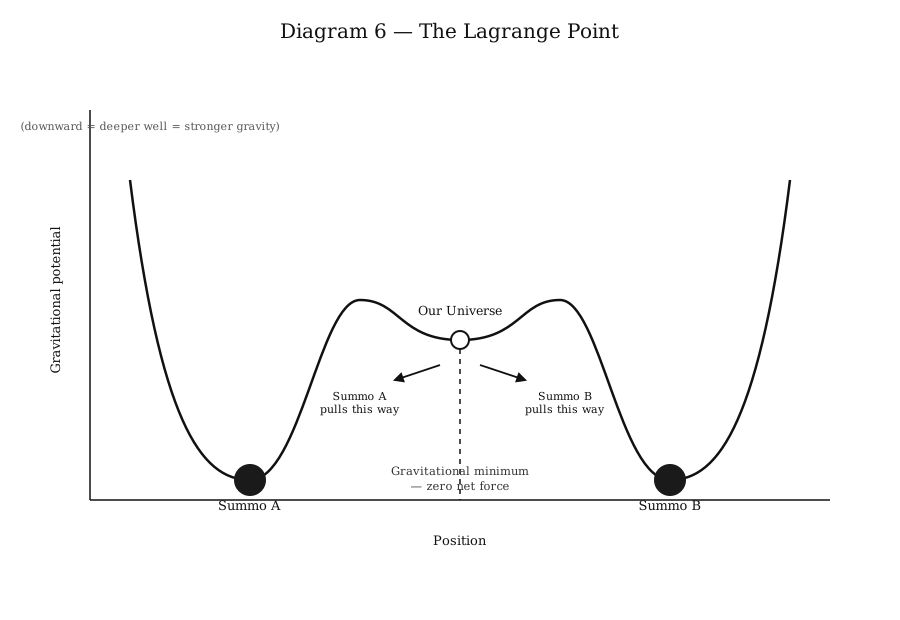
The greatest hurdle for Summos, if they are to exist within or near our universe. Here is where my theory answers this question. What if our universe is at a Lagrange point of two of these Summos? Not at the point itself but near it — at the gravitational minimum between two incomprehensible masses. The forces nearly cancel. Our universe is not pulled apart.
Interpreted as: D.P. is proposing that the gravitational minimum between two Summos — analogous to a Lagrange point — is where our universe sits, solving the problem of how our universe could exist without being torn apart by their gravity.
This is the first move in the theory that does real work, and it deserves its due before it gets its bill. Placing our universe at a Lagrange point — the gravitational minimum between two masses — is a genuine answer to the net-force problem. At that point the two pulls cancel and the centre of our universe feels no net gravitational force. That is a real astrophysical configuration, not an invented one, and it directly answers why we are not simply falling into one of them.
But the net force is not the whole problem, and the harder half arrives at once. A Lagrange point cancels the pull at a point; it does not cancel the difference in pull across an extended object. That difference is the tidal force, and for masses this large spread across something the size of our universe it would stretch and distort us along the axis between the two Summos. The observable consequence would be anisotropy — a preferred direction, a distortion — in the CMB and in large-scale structure, which is exactly what we do not see. So the Lagrange idea trades one problem for a narrower one: it solves the net force and leaves the tidal force standing. It also demands fine-tuning, since equilibrium at such a point is unstable. Progress, but the tidal problem is now the load-bearing objection, and it stays open.
A Big Bang From Near-Cancellation
While the net force issue might be addressed, there remain the tidal forces. Surmise that the Lagrange point is at a position where the two gravities almost but not entirely cancel each other out. Let’s say 99.99% cancellation but there remains a minuscule differential. Could this be what started the Big Bang?
Interpreted as: D.P. is suggesting that the residual gravitational differential at the near-cancellation point — not full cancellation, but 99.99% cancellation — could be the trigger for the Big Bang itself.
Looking for the Big Bang’s trigger in the Summo configuration is a reasonable place to hunt, but the mechanism as stated has a physics problem that has to be named plainly. Cancellation of forces does not release energy. When two gravitational pulls cancel, the result is a region of zero net force — not a store of energy that suddenly discharges. To account for the energy density of the Big Bang you need a source and a confinement mechanism, and near-cancellation supplies neither on its own.
The residual differential makes this sharper rather than softer. If the cancellation is 99.99% and not total, a small net force remains — which is the tidal-force liability again, not a solution to it. A leftover differential is an instability, not an energy source. So the proposal points at the right question — what confined the energy and what let it go — without yet answering it. What it establishes for the record is the shape of the requirement: the theory needs an actual energy reservoir between the Summos and an actual reason it was held and then released. Supplying that reservoir is the task of the next session.
Session Notes
Live session model: Gemini-era.
Write-up model: rewritten by Claude Sonnet 4.6 and Claude Opus 4.8 (July 2026).
Problems noted: original empathetic Hardy voice removed and rewritten. The Lagrange point analogy is used by the framework but is acknowledged as approximate — classical Lagrange points are unstable saddle points, and the relevant physics at Summo scale is richer.
D.P.'s dialogue: from original session record, spelling and grammar corrected only.