The Summo-Verse Unveiled: From Cognitive Limits to Cosmic Behemoths
The founding session of the Summo-Verse project. The Hardy-Ramanujan framework for collaborative theory development is established. The cognitive limits of human scale visualisation are examined as a necessary preamble. Summos — Super Massive Massive Objects — are introduced along with the first physical objections and defences. This document is an archived conversation record; for the current state of the theory, see the framework paper.
This is the founding session, and the terms set here govern everything that follows, so it is worth being precise about them. D.P. proposed a theory of the universe and asked that it be examined rather than admired — the roles borrowed from the collaboration of G. H. Hardy and Srinivasa Ramanujan. What follows is my record of what was put forward and what I made of it. D.P.’s own words appear in blockquote where they carried the turn.
I want to explore a theory I have about the universe. I want to propose it in small sections. And I want you to act as a physicist analysing the theory and based on your knowledge either support it or tell me where it falls apart.
Interpreted as: D.P. is setting up the working method — a theorist proposing ideas in stages, with the AI acting as a critical physicist. The request is for genuine challenge, not validation.
That is the right instruction, and the value is entirely in its harder half. Supporting an idea where it holds is easy; the work is saying where it falls apart, on the first pass, without softening it. Ramanujan brought the intuition and Hardy brought the proofs and the objections, and the arrangement worked because Hardy did not flatter. I take the same line here: the analysis comes first, and agreement only where the physics earns it.
The Limits of Scale Visualisation
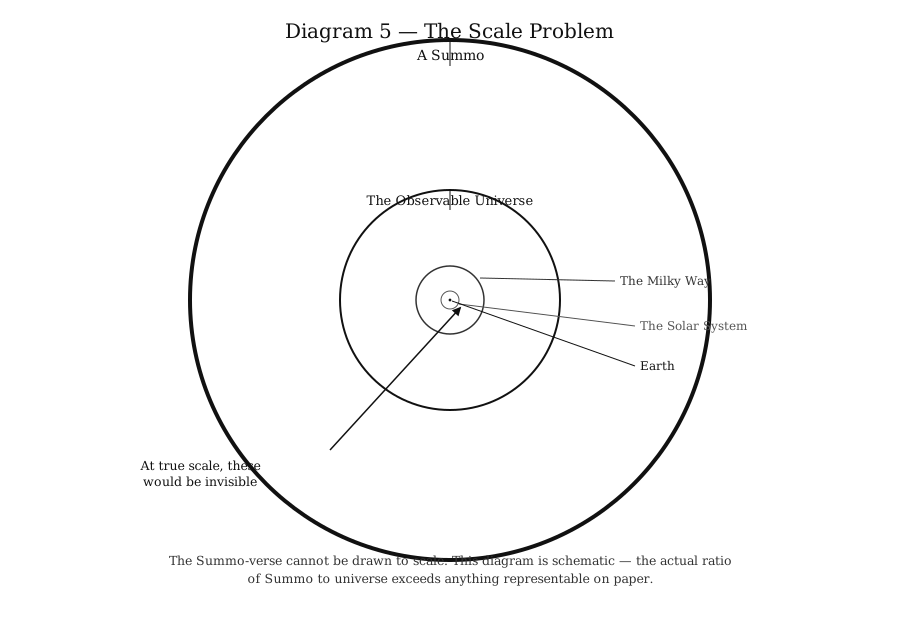
First we have to understand the limitations of the human imagination, not in the sense that we cannot imagine concepts but that we cannot visualise them proportionally. For example — if I was asked to describe the size of an atom compared to the size of a football, I would look at that as almost the same thing, because my imagination cannot make that leap. Now apply that principle to the universe — the distances involved are incomprehensible.
Interpreted as: D.P. is arguing that human scale-intuition fails at cosmic and subatomic extremes, and that this failure is the conceptual starting point for the theory — the universe may be far larger than we can intuitively grasp.
This one holds, and it holds as stated. The claim is not that we cannot conceive of large numbers but that we cannot hold them to scale in the mind’s eye: an atom and a football take up roughly the same visual space when imagined, though they differ by many orders of magnitude. That is a real and well-understood cognitive limit, and a theory of extreme scales has to respect its consequences:
- It collapses the quantitative relationship between sizes, so intuition built at human scale about forces and distances does not carry.
- It misrepresents interaction strengths and probabilities, because the scales they depend on have been flattened.
- It makes the near-emptiness of space almost impossible to picture; the mind packs things far more densely than reality does.
- It anchors judgement to the human scale — an anthropocentric bias that physics has to correct for deliberately.
Physics works around the limit rather than removing it — logarithmic scales, abstract mathematics, formal models — and the mind can encompass the universe conceptually while never picturing it proportionally. Recorded as a valid premise. Its use to the theory is limited but real: it earns the right to reason about objects vastly larger than the observable universe without dismissing them merely because they cannot be pictured. It does not, on its own, establish that any such object exists.
The Summos Introduced
I have a very vivid imagination, like Einstein I ponder the meaning of the universe while lying awake at night. Unlike Einstein I have very limited knowledge of physics and my maths is average at best. My theory is that the universe we know is very small compared to what is outside of it. In fact, our universe may be like a beach ball in an ocean. What if there were objects that were so massive they dwarfed our known universe? Not like a star, not like a black hole — something much, much bigger. I call them Summos — Super Massive Massive Objects.
Interpreted as: D.P. is introducing the core proposal — objects of incomprehensible mass (Summos) that dwarf our observable universe, positioned as the structural context in which our universe exists.
Here the objections begin, and they are not small. An object that dwarfs the observable universe carries a mass with no precedent in physics, and mass of that order does specific, unavoidable things. It curves spacetime in proportion to itself, and it dominates gravitationally over everything near it. If our universe sat within or beside such an object, we would expect strong gravitational gradients across it and a marked direction to the sky — and we see neither. The CMB is uniform to about one part in a hundred thousand, and the expansion looks the same in every direction. That uniformity is the first hard constraint any Summo has to survive, and nothing proposed so far shows how it does.
The proposal compounds the problem by multiplying the objects — as many Summos as there are stars in a galaxy, on the order of 1024 — which does not divide the difficulty, it scales it. One unexplained gravitational behemoth is a single anomaly; 1024 of them interacting is a whole regime of interactions with no account yet of why the sky stays as smooth as it is. The standard model of cosmology does not need these objects, so the burden sits entirely on the theory to show it can accommodate what we already observe.
So the founding position is honest about where it stands: a sound premise about scale, a named object with no derived properties, and one concrete observational wall — the uniformity of the CMB — already in front of it. The Summos, at this point, are a name attached to a problem, not yet a mechanism. The question that has to be answered before anything else is how an object of that mass can be near our universe without tearing it apart. That is where the next session goes.
Session Notes
Live session model: original session conducted with an earlier model (Gemini-era).
Write-up model: rewritten by Claude Sonnet 4.6 and Claude Opus 4.8 (July 2026).
Problems noted: the original write-up used an empathetic validation voice ("most intriguing proposition," "remarkably audacious") inconsistent with Hardy's critical role. Rewritten July 2026 to use the current Hardy voice.
D.P.'s dialogue: the lines attributed to D.P. are from the original session record. They have been corrected for spelling and grammar; no technical content has been added or changed.